
Healthcare Reputation Specialists
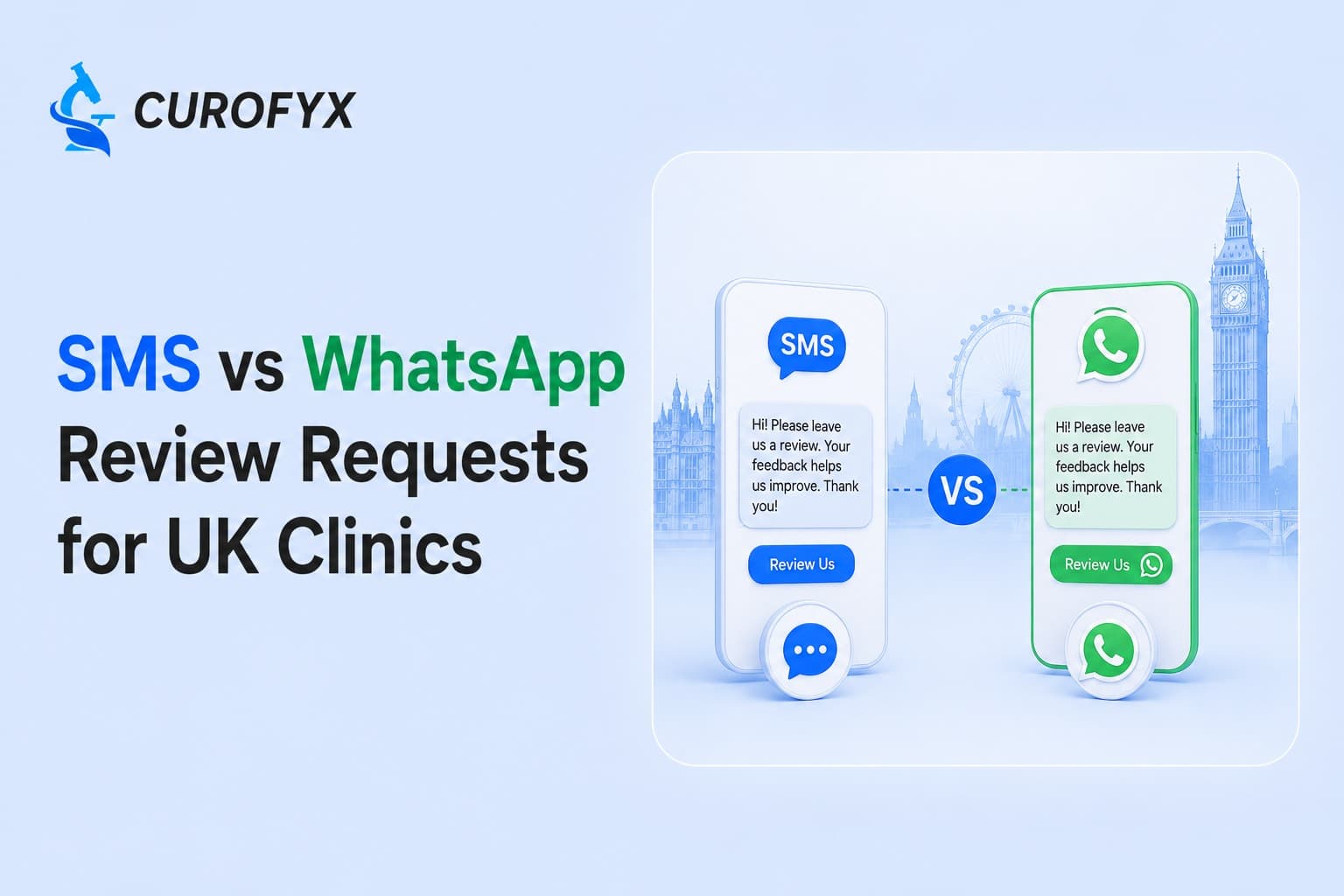
Should your clinic ask patients for reviews via SMS or WhatsApp? This guide compares open rates, response behaviour, costs, GDPR considerations, and patient preferences to help UK healthcare providers choose the most effective review request strategy.
Patient reviews have become one of the most influential factors in healthcare marketing. Whether someone is searching for a private GP, dental practice, physiotherapy clinic, cosmetic clinic, or specialist consultant, online reviews often shape their decision before they visit your website or make a phone call.
Collecting those reviews, however, depends on asking patients at the right time—and through the right communication channel.
For many UK clinics, the question is no longer whether to request reviews, but how to do it effectively. Two of the most common options are SMS review requests and WhatsApp review requests. Both offer fast delivery, high visibility, and the ability to send patients directly to platforms like Google, Trustpilot, Doctify, or the NHS website.
Yet they perform differently depending on patient demographics, communication preferences, compliance requirements, and the type of healthcare service you provide.
So which channel delivers better results?
The answer isn't as simple as choosing one over the other. SMS offers near-universal reach and simplicity, while WhatsApp enables richer, more conversational interactions. Understanding the strengths and limitations of each can help clinics increase review response rates, strengthen their online reputation, and improve patient engagement without adding administrative work.
In this guide, we'll compare SMS and WhatsApp review requests across open rates, patient behaviour, messaging costs, GDPR compliance, and practical use cases for UK healthcare providers.
Most patients are willing to leave a review after a positive healthcare experience—but only a small percentage will do so without being prompted.
The reason isn't dissatisfaction. It's simply that people are busy.
A timely review request reminds patients while their experience is still fresh and significantly increases the likelihood of receiving genuine feedback.
Consistent review collection helps clinics:
Whether you choose SMS, WhatsApp, or a combination of both, consistency is usually more important than occasional review campaigns.
When evaluating any patient communication channel, the first metric many clinics consider is the open rate.
A message that isn't seen can never generate a review.
Both SMS and WhatsApp perform considerably better than email for time-sensitive patient communications, but they achieve this in different ways.
SMS remains one of the most reliable communication channels available.
Because text messages are delivered directly to a patient's mobile phone without requiring a specific app or internet connection, they are rarely missed.
Industry research consistently shows that SMS messages achieve very high open rates, often exceeding those of email by a significant margin. Many recipients view text messages within minutes of receiving them, making SMS particularly effective for appointment reminders, follow-ups, and review requests.
For healthcare providers, this means a review request sent shortly after an appointment has an excellent chance of being seen while the patient's experience is still fresh.
Advantages of SMS
The simplicity of SMS is one of its greatest strengths.
Patients receive a short message containing a review link, tap it, and leave their feedback.
WhatsApp has become one of the world's most widely used messaging platforms, with millions of active users across the UK.
Many patients already use WhatsApp daily to communicate with family, friends, and businesses, making it a familiar environment for receiving updates.
Messages often feel more conversational than SMS and can include:
For patients who actively use WhatsApp, review requests can feel more personal and engaging.
However, unlike SMS, WhatsApp depends on:
Although adoption is widespread, not every patient prefers WhatsApp for healthcare communication.
In practice, both channels achieve excellent visibility.
SMS benefits from:
WhatsApp benefits from:
The real objective is generating authentic patient reviews.
Whether you choose SMS or WhatsApp, sending the message at the right moment has a major influence on success.
Patients are generally more likely to leave a review when:
Many clinics find that review requests sent within 24 hours of an appointment perform better than messages sent several days later.
Automation makes this timing consistent without increasing administrative workload.
Choosing between SMS and WhatsApp isn't only about technology.
It's also about understanding how patients prefer to communicate.
Communication habits vary depending on:
Some patients still regard SMS as the most trustworthy channel for healthcare messages because it has long been used for appointment reminders and NHS notifications. Others increasingly expect businesses to communicate through WhatsApp because it's already integrated into their daily lives. Understanding these behavioural differences helps clinics select the right channel—or combination of channels—for different patient groups.
Patients are more likely to interact with review requests from organizations they recognize.
Regardless of whether you use SMS or WhatsApp, every message should clearly identify:
Messages that appear anonymous or overly promotional are more likely to be ignored.
Simple, professional communication generally performs better than marketing-heavy copy.
Patients are far more likely to respond when a message feels personal rather than automated.
Simple personalization can include:
Small details like these make review requests feel genuine without adding significant administrative effort.
Open rates and patient engagement are important, but clinics also need to consider the financial side of their communication strategy.
For practices sending hundreds or thousands of review requests every month, messaging costs can quickly become part of the marketing budget.
Fortunately, both SMS and WhatsApp remain relatively inexpensive compared with the potential value of a new patient.
SMS pricing usually depends on:
In the UK, businesses typically pay a small fee for each outbound SMS.
Advantages include:
For most clinics, SMS remains one of the most cost-effective communication channels because of its simplicity and universal compatibility.
WhatsApp Business messaging follows a different pricing model.
Costs generally depend on:
Unlike SMS, pricing is not always based purely on individual messages. Instead, some providers charge according to messaging conversations initiated within specific time windows.
Although this model can appear more complex, it also enables richer interactions that extend beyond simple review requests.
For most clinics, the objective isn't simply reducing messaging costs.
The real goal is:
If one additional positive review leads to multiple new patients over the coming months, the cost of sending dozens of review requests becomes relatively insignificant.
That is why many successful clinics measure:
rather than focusing solely on cost per message.
Not necessarily.
Increasingly, healthcare providers are adopting a multi-channel review request strategy.
For example:
Used for:
Used for:
This hybrid approach allows clinics to maximise reach while giving patients the opportunity to interact through their preferred communication channel.
Whether you use SMS, WhatsApp, or both, manual messaging quickly becomes difficult as patient numbers grow.
Automated review request systems can:
Automation also ensures every patient receives a consistent experience instead of relying on reception staff to remember manual follow-ups.
For clinics managing multiple locations, automation helps maintain consistent reputation growth across every practice.
For UK healthcare providers, choosing a communication channel isn't just about open rates or costs. Every patient message must also comply with UK data protection requirements and respect patient privacy.
Because healthcare organisations process sensitive personal information, communication practices should align with the UK GDPR, the Data Protection Act 2018, and any applicable professional guidance.
Whether you use SMS, WhatsApp, or both, patient trust should always come first.
SMS has been widely used by NHS organisations and private healthcare providers for years, particularly for appointment reminders and follow-up communication.
When used appropriately, SMS can be a compliant and effective method for requesting patient feedback.
Good practice includes:
contains minimal personal information while making the purpose of the message clear.
WhatsApp Business offers richer communication features but also requires careful consideration.
Before using WhatsApp for patient communication, clinics should ensure they have an appropriate legal basis for processing personal data and that patients understand how the platform will be used.
Many clinics choose WhatsApp because it allows:
However, healthcare providers should avoid discussing confidential medical information unless appropriate safeguards are in place.
Review requests should remain simple and avoid including:
There is no universal winner in the SMS vs WhatsApp review requests debate.
The most effective communication channel depends largely on who your patients are.
Below are some practical recommendations based on common UK healthcare demographics.
General practice patients span all age groups and levels of digital confidence.
Recommended approach:
SMS offers broad accessibility and ensures almost every patient can receive review requests without downloading additional applications.
Dental patients often visit regularly and may already receive appointment reminders by text.
Recommended strategy:
This combination balances reach with convenience.
Patients attending cosmetic and aesthetic clinics are typically highly engaged online and often communicate through messaging apps.
For many cosmetic clinics:
Rich messaging can feel more personal while maintaining a professional tone.
Physiotherapy patients often attend multiple appointments over several weeks.
WhatsApp works particularly well for:
SMS remains effective for appointment reminders and patients who prefer traditional communication.
Specialist healthcare providers usually communicate formally with patients.
Many clinics therefore continue to rely primarily on SMS while gradually introducing WhatsApp for patients who specifically prefer it.
Neither channel is universally better. SMS offers broader reach and simplicity, while WhatsApp provides richer communication. The best choice depends on your patient demographics and communication preferences.
SMS is widely recognised for its exceptionally high visibility because messages are delivered directly to mobile devices without requiring an additional application. This makes it highly effective for time-sensitive healthcare communications.
Yes, provided clinics use it appropriately, communicate transparently, and comply with UK data protection requirements. WhatsApp can be particularly effective for patients who already engage with the clinic through the platform.
For many healthcare providers, a hybrid approach delivers the best results. SMS ensures broad coverage, while WhatsApp offers a more engaging experience for patients who prefer messaging apps.
Many clinics achieve strong results by sending review requests within 24 hours of an appointment, while the patient's experience is still fresh. Automated workflows help ensure messages are sent consistently.
Yes. Modern healthcare reputation management platforms allow clinics to automatically send SMS or WhatsApp review requests after appointments, track responses, monitor reviews across multiple platforms, and measure campaign performance.
Choosing between SMS and WhatsApp review requests isn't about finding a single winner—it's about understanding your patients and communicating in the way that's most convenient for them.
SMS remains the most universally accessible option. It works on virtually every mobile phone, delivers messages quickly, and continues to be trusted for healthcare communications. For many GP practices, dental clinics, and specialist providers, it's an excellent foundation for collecting patient reviews.
WhatsApp, meanwhile, offers a richer and more conversational experience. Clinics with younger, digitally engaged patients—such as cosmetic, physiotherapy, or wellness practices—may see stronger engagement when review requests are delivered through a familiar messaging platform.
Platforms like Curofyx make this process significantly easier by automating review requests through SMS and WhatsApp, monitoring reviews across Google, NHS, Doctify, Trustpilot, and other healthcare platforms, and using AI to help clinics respond quickly and professionally. Rather than choosing between channels, clinics can build a flexible, patient-first review strategy that improves both reputation and long-term growth.
Get a live 1-on-1 walkthrough tailored to your clinic’s workflow and see how easily you can automate review requests, monitor your reputation, and reply with AI.