
Healthcare Reputation Specialists
Most AI review tools write replies that could just as easily belong to a coffee shop as a clinic. Healthcare is different. Patients expect empathy, professionalism and confidentiality. Here's how AI-powered review replies work when they're built specifically for UK healthcare practices, and why they can save hours without sacrificing quality.
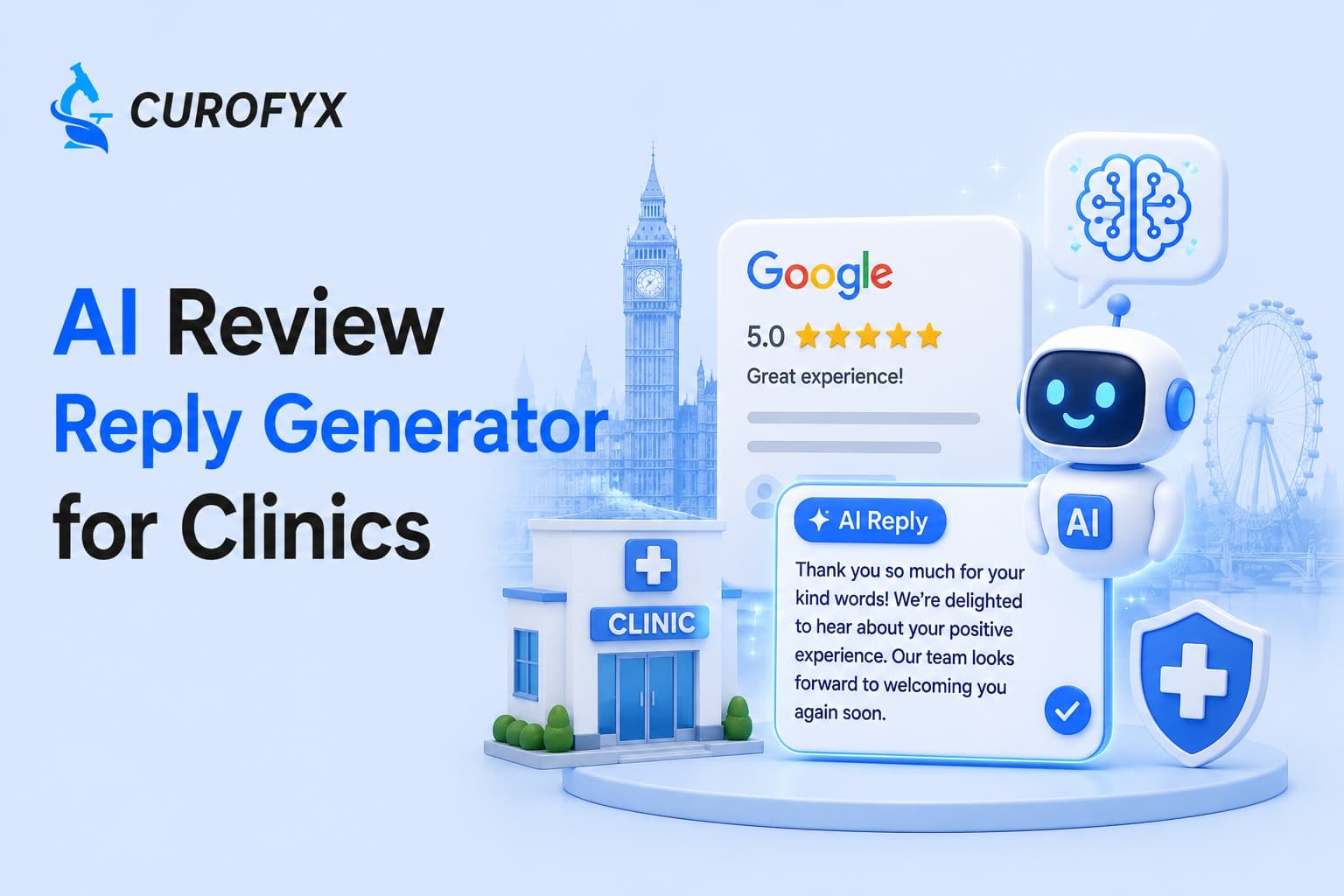
A clinic might receive 30, 50 or even 100 Google reviews each month. Everyone agrees they should be answered because patients notice them, Google notices them and prospective patients definitely notice them. Then reality gets in the way. Reception gets busy. The practice manager is covering annual leave. Clinicians are seeing patients. Review replies quietly become another task that slips down the list.
The obvious solution seems to be AI. The problem is that most AI reply generators have clearly never worked with a healthcare provider. They thank patients for "shopping with us", promise to "see you again soon" or produce replies that sound so polished they feel completely unnatural.
Healthcare needs something different. Patients aren't reviewing a takeaway or a clothing retailer. They're talking about appointments, treatments, anxiety, waiting times and trust. Every response represents your clinic publicly. A generic reply isn't just ineffective. It can make the practice look careless. That's why healthcare-specific AI matters.
Think of AI as your first draft writer, not your final decision-maker. A good healthcare review platform reads the context of the patient's review, understands whether it's positive, neutral or negative, then produces a suggested response that matches the tone your practice wants to present.
The difference between a general AI model and one designed for clinics is immediately obvious.
Imagine these two reviews.
"Dr Ahmed was brilliant. She explained everything clearly and made me feel at ease."
A generic AI might write:
"Thank you for your wonderful feedback. We appreciate your business."
Technically correct.
Completely wrong for healthcare. A healthcare-focused AI would recognise that reassurance and communication were the themes that mattered. A stronger reply would look something like this:
"Thank you for taking the time to leave your feedback. We're delighted to hear you felt well supported during your appointment, and we'll be sure to share your kind comments with Dr Ahmed and the team."
It feels human because it reflects what the patient actually said. That's the benchmark clinics should expect.
One concern many healthcare managers have is whether AI might create details that were never mentioned.
It shouldn't. A well-designed review assistant drafts replies using only the information already available in the review together with your preferred response style. It doesn't fabricate treatments, appointment dates or clinical outcomes. That matters because accuracy matters. Patients trust healthcare organisations to communicate carefully, even in something as simple as a Google reply.
This is where many AI reply generators fall apart.
They're trained on everything. Restaurants. Hotels. Retail. Online shopping. Healthcare becomes just another category. The result is predictable. Replies start thanking patients for their "purchase", encouraging them to "visit again soon" or sounding overly cheerful in situations that require empathy.
Imagine replying to this review:
"I was extremely anxious before my procedure, but the nurse made me feel calm."
A retail-style AI might produce:
"Fantastic! We're so happy you had a five-star experience!"
Nothing about that response feels appropriate. A healthcare-aware AI recognises that the review isn't celebrating convenience. It's acknowledging emotional support. That's an entirely different conversation.
There's another mistake worth mentioning. Some practices try so hard to sound professional that every response becomes stiff. Others go too far the other way and become overly casual. Neither builds confidence.
Patients generally respond well to replies that are:
Finding that balance consistently is difficult when dozens of replies need writing every week. It's exactly the sort of repetitive communication task AI handles well.
Healthcare replies have an extra rule that most industries don't face. Never confirm clinical details publicly. Even when a patient openly discusses their treatment, your response shouldn't expand on that information.
For example, if someone writes:
"Thank you for helping with my skin cancer diagnosis."
The safest reply isn't to discuss the diagnosis further. Instead, it focuses on gratitude and support while respecting patient confidentiality. That distinction matters. It's one reason generic AI often produces replies that healthcare providers should never publish without checking first.
Some software companies promise fully automated review replies with no approval required. Personally, I think that's the wrong approach for healthcare. A five-star review about parking probably doesn't need much editing. A detailed complaint involving waiting times, communication or clinical care almost certainly does. The goal isn't to replace judgement. The goal is to remove the blank page.
Instead of spending five minutes writing every reply from scratch, your team spends twenty seconds reviewing, making small edits if needed and approving the response. That difference adds up quickly. For a busy clinic receiving hundreds of reviews every month, AI can return several hours to the practice manager without lowering the quality of patient communication. The best AI review assistant isn't the one that writes everything automatically.
The biggest time saving isn't that AI writes the reply. It's that your team no longer has to jump between multiple systems to finish the job.
A typical manual workflow looks something like this:
Repeat that thirty times on a Monday morning and you've lost the best part of an hour. A healthcare review platform should remove those unnecessary steps. With Curofyx, the review appears inside your dashboard, an AI draft is generated automatically, you make any changes you want and publish the response from the same place.
No copy and paste. No switching tabs. No starting from a blank page. That might sound like a small improvement, but reception teams and practice managers quickly notice the difference.
Patients don't expect an answer within five minutes. They do notice when reviews have been sitting unanswered for three months. An active review profile tells prospective patients something important. It shows the clinic is paying attention.
Imagine comparing two private clinics.
Clinic A
Clinic B
Most people naturally trust Clinic B more.
Not because every review is five stars, but because someone is clearly listening. Google also values active business profiles. While replying to reviews isn't a direct ranking factor on its own, an actively managed profile sends positive engagement signals that support your overall local SEO strategy.
One clinic can usually manage reviews manually. Five clinics become harder. Twenty clinics become a reporting problem. Healthcare groups often struggle because every location replies differently. One branch writes warm, personal responses. Another posts one-line replies. A third rarely replies at all. Patients notice that inconsistency. AI helps standardise quality while still allowing each location to personalise replies where appropriate. If you're managing multiple locations, Curofyx's solution for Multi-Branch Healthcare Groups helps centralise review management while giving local teams the flexibility to approve responses before they're published.
Negative reviews are where AI becomes genuinely useful. Not because AI should handle complaints automatically. Because people rarely write their best responses when they're frustrated. A one-star review lands in your inbox. You know the situation isn't as simple as the reviewer describes.
Your first draft is probably defensive.
That's completely normal. It's also exactly why a drafting assistant helps. Instead of reacting emotionally, AI starts with a calm, professional response that your team can edit before publishing.
Consider this review:
"I waited nearly an hour past my appointment time. Nobody apologised."
An unhelpful response would immediately explain why the clinic was busy. That may even be true. But prospective patients reading the exchange don't know that. The better response starts by acknowledging the patient's experience.
For example:
"Thank you for sharing your feedback. We're sorry your appointment didn't begin as expected. We understand how frustrating delays can be and appreciate you bringing this to our attention. We'll review your comments with the team as part of our ongoing service improvements."
Notice what's missing.
No excuses. No argument. No suggestion that the patient is wrong. That approach almost always reflects better on the practice.
Not every review should receive a standard response. Some deserve escalation before anyone replies.
For example:
Rather than generating an instant reply, a healthcare-specific AI should identify these reviews and recommend manual handling. That's a feature, not a limitation. The safest AI knows when not to answer.
This is probably my biggest criticism of some AI review tools. They promise complete automation. Healthcare simply isn't the place for that. Reception staff, practice managers or marketing teams should always have the opportunity to review and edit responses before they're published. AI should speed up decision-making.
There's a misconception that using AI means giving up control. It doesn't. In fact, the best healthcare AI does the opposite. It gives your team a strong first draft while keeping every publishing decision firmly in human hands.
Every suggested reply can be:
That flexibility matters because no two reviews are identical. A two-line thank you for a five-star review shouldn't read like a response to a detailed complaint about appointment delays. The AI should recognise that difference. Your team should always have the final say.
Writing thoughtful responses from scratch is manageable when your clinic receives ten reviews a month. At fifty, it becomes another administrative task. At two hundred, it usually stops happening altogether. That's the pattern I've seen repeatedly. Clinics don't ignore reviews because they don't care. They ignore them because replying consistently takes time, and time is usually in short supply.
Here's a simple comparison.
| Manual Replies | AI-Assisted Replies with Curofyx |
|---|---|
| Start with a blank page | AI creates a first draft instantly |
| Tone varies between staff members | Consistent brand voice |
| Easy to miss replies during busy periods | New reviews appear in one dashboard |
| Slower response times | Faster approvals and publishing |
| Difficult to maintain across multiple branches | Standardised workflows for every location |
| Every reply written from scratch | Edit and approve in seconds |
The goal isn't to eliminate human involvement. The goal is to eliminate repetitive work.
AI replies aren't a replacement for good reputation management. They're one part of it.
The clinics with the strongest online reputations usually combine several habits:
AI simply removes one of the most repetitive parts of that process. If you're already investing in your Google Business Profile, using AI to maintain fast, consistent responses is a logical next step.
For practices deciding whether to rely solely on Google or use a dedicated healthcare reputation platform, our comparison of Curofyx vs Google Business Profile explains the differences.
This is where I think some software companies get the messaging wrong. They sell AI as though the objective is to remove people from the process. Healthcare has never worked that way. Patients still expect empathy. They still expect accountability. They still expect someone to read what they've written. AI helps your team respond more quickly and more consistently, but patients should never feel like they're talking to a machine. If they do, the technology has failed. The best AI is almost invisible. Patients simply see a clinic that communicates well.
It can, but healthcare providers should avoid fully automated publishing. A safer approach is for AI to generate a draft that your team reviews and approves before it goes live.
Yes, provided it acts as a drafting assistant rather than making decisions. AI can create calm, professional responses while allowing staff to edit them before publishing.
A healthcare-focused platform can learn your preferred communication style, making replies feel consistent with your brand instead of sounding generic.
It helps by reducing the time spent writing review responses and keeping your Google Business Profile active with timely, consistent engagement.
It can support compliance by avoiding unnecessary references to treatments or medical conditions, but every response should still be reviewed by a member of your team before publication.
Yes. AI helps maintain a consistent response style across multiple branches while allowing local managers to personalise replies where appropriate.
The biggest win isn't saving thirty seconds on a reply. It's building a reputation that feels active. Patients notice when reviews receive thoughtful responses. They notice when concerns are acknowledged. They notice when a clinic consistently communicates with professionalism instead of leaving months of feedback unanswered. That's what AI should help you achieve. Not replacing your team, but giving them the time to focus on patients while still presenting a responsive, trustworthy practice online.
Get a live 1-on-1 walkthrough tailored to your clinic’s workflow and see how easily you can automate review requests, monitor your reputation, and reply with AI.