
Healthcare Reputation Specialists
Many healthcare providers assume online reviews have nothing to do with a CQC inspection. That isn't entirely true. While Google or Trustpilot ratings don't directly affect your CQC score, inspectors increasingly use patient feedback to understand whether people's experiences match what they observe on site. Here's how review data fits into modern inspection preparation.
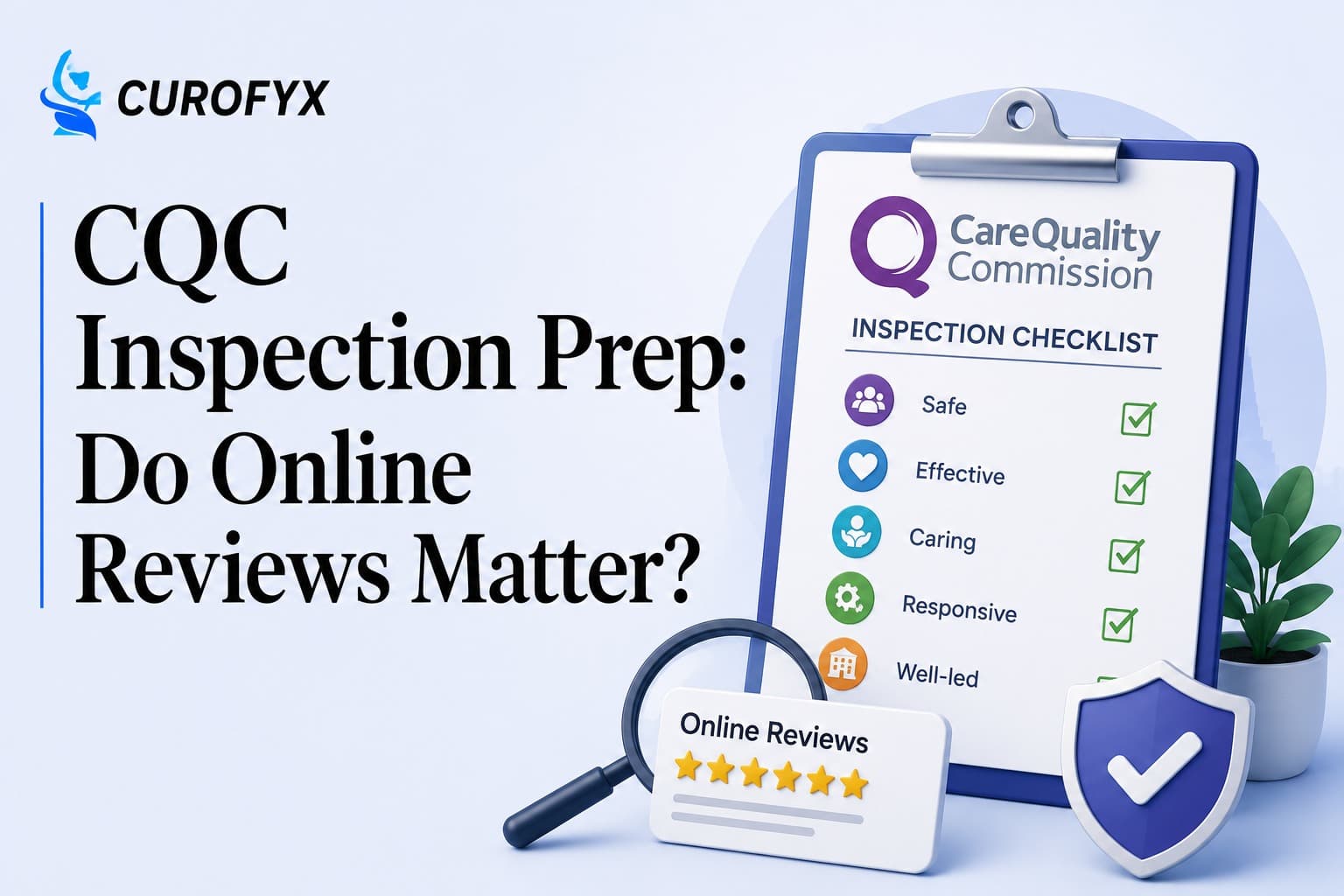
A week before a scheduled CQC inspection, most practice managers begin the same routine. Policies are updated. Mandatory training records are checked. Complaint logs are reviewed. Clinical audits are printed. Staff make sure mandatory documentation is complete. Then someone remembers Google.
Usually because a negative review appeared the previous weekend. That approach is backwards. Online reviews shouldn't become important only because an inspection is approaching. They should be treated as continuous patient feedback that helps identify issues months before an inspector ever walks through the door. The Care Quality Commission does not award ratings based on your Google score or the number of five-star reviews you receive. An "Outstanding" provider can still have occasional negative reviews, and a provider with hundreds of positive Google ratings can still receive a lower inspection outcome if governance or patient safety falls short.
But dismissing online reviews completely is equally misguided. Inspectors increasingly look for consistency between what patients say publicly, what your complaints process records internally, and what staff tell them during interviews. If all three point in the same direction, confidence grows. If they tell different stories, inspectors are likely to ask more questions. That is why reputation management has become part of good operational governance rather than simply a marketing exercise.
This is probably the most common question practice managers ask before an inspection. The short answer is yes, but not in the way many people think. The CQC does not have a scoring system that awards points for having a 4.9-star Google rating. There is no inspection framework saying providers must collect a certain number of online reviews. Instead, inspectors gather information from a wide range of feedback sources before and during inspections.
Those sources can include:
The key phrase is publicly available information. If several recent Google reviews mention long waiting times, poor communication or difficulties contacting reception, inspectors may ask how the organisation has investigated those concerns. Likewise, if dozens of reviews consistently praise staff compassion, clear communication and excellent continuity of care, those comments help reinforce other evidence inspectors collect.
Some providers deliberately avoid responding to online reviews because they believe the platforms are unreliable or unfair. Patients sometimes post anonymous criticism. Some reviews contain incomplete information. Others describe situations that staff remember very differently. But ignoring reviews creates another problem. Inspectors don't necessarily expect every negative review to disappear. They do expect organisations to demonstrate they listen to patient feedback.
Imagine two GP surgeries. Both receive five negative reviews over six months discussing appointment delays. Practice A leaves every review unanswered. Practice B responds politely, explains improvement work, reviews appointment capacity internally and records changes in waiting times. Which organisation appears more responsive? The second one. The issue wasn't the reviews. It was how leadership reacted to them. That distinction matters throughout the CQC framework, especially within governance.
One misconception is that reviews only influence public perception. In reality, recurring themes within reviews often overlap with two of the most closely examined areas during inspection: Well-led and Caring.
The Well-led assessment focuses heavily on leadership, governance, learning and continuous improvement. Inspectors want evidence that leaders know what is happening across the organisation. If Google reviews repeatedly mention reception delays, unanswered telephones or poor communication, leadership should already be aware of those patterns. More importantly, they should be able to demonstrate what action followed.
For example: A private clinic notices six reviews within two months mentioning confusion around appointment confirmation emails. Instead of dismissing the comments individually, management investigates booking workflows, updates patient communications and introduces automated reminders. Three months later, similar complaints disappear. During inspection, that becomes evidence of responsive governance. Not because Google demanded it. Because leadership used patient feedback to improve services. This is exactly the type of continuous quality improvement inspectors like to see.
The Caring assessment looks beyond clinical competence. Inspectors examine whether patients feel respected, listened to and treated with dignity. Those are precisely the subjects patients naturally write about online.
Positive reviews frequently mention:
Negative reviews often focus on:
Inspectors never assume every review is completely accurate. Instead, they look for patterns. One isolated complaint rarely changes anything. Twenty reviews describing exactly the same experience deserve attention. That is why monitoring review trends is far more valuable than monitoring star ratings alone.
The short answer is yes, but probably not in the way many providers assume. The Care Quality Commission does not award ratings based on Google stars or Trustpilot scores. There is no minimum review rating required for an Outstanding inspection, and a provider with hundreds of five-star reviews is not automatically viewed more favourably than one with fifty.
That said, online feedback has become an increasingly valuable source of intelligence before and during inspections.
Under its current Single Assessment Framework, CQC draws evidence from multiple sources instead of relying solely on what inspectors observe during an inspection day. These sources include direct patient and family feedback, complaints, compliments, staff interviews, local authority information, safeguarding notifications, Healthwatch reports and publicly available information. Online reviews often fall into that wider evidence picture because they reflect experiences shared voluntarily by patients, relatives and carers.
Inspectors are unlikely to quote individual Google reviews in an inspection report. What they are far more interested in is whether recurring themes online match what they hear elsewhere.
For example, imagine a nursing home where twenty recent Google reviews repeatedly mention unanswered call bells, slow response times and poor communication with families. During inspection, relatives interviewed on-site raise the same concerns. Staff surveys reveal similar frustrations, and complaint logs show increasing response times over the previous six months. The online reviews are not creating the problem. They are simply reinforcing a pattern that already exists.
The opposite is equally true. Consistent positive feedback about compassionate staff, clear communication, dignity, cleanliness and responsive care supports evidence gathered from interviews and observations. It demonstrates that positive experiences are happening consistently, not only on inspection day. Healthcare providers sometimes dismiss online reviews because "CQC doesn't score Google."
That mindset misses the point. CQC is interested in people's lived experiences. Online reviews have become one of the easiest ways for inspectors to understand those experiences before they even step through the front door. For organisations using platforms like Curofyx, collecting reviews is only one part of preparation. Monitoring trends across Google, Trustpilot and sector-specific review platforms gives management teams an early warning system months before inspection, allowing issues to be addressed before they become recurring evidence.
Online reviews rarely influence only one CQC quality statement. In practice, they often provide evidence across several assessment areas, particularly "Well-led" and "Caring."
The Caring domain focuses on whether people are treated with kindness, dignity, compassion and respect. Family members naturally describe these experiences in reviews. Comments such as "The nurses treated Mum with incredible kindness" or "Staff explained everything clearly during a difficult time" reinforce exactly the type of evidence inspectors seek through interviews and observations.
Likewise, repeated complaints about dismissive reception staff, poor bedside manner or rushed appointments raise questions about consistency of care. Healthcare is emotional. Patients rarely leave reviews discussing clinical protocols. They talk about how people made them feel. That makes review platforms particularly valuable when assessing Caring.
The Well-led domain is different. Here, inspectors look for evidence that leaders identify problems, respond appropriately and create a culture of continuous improvement. This is where many providers lose marks unnecessarily. Negative reviews themselves are not usually the issue. Ignoring them is. Consider two dental practices that both receive identical complaints about appointment delays.
Practice A never replies. The same complaint appears repeatedly over six months. Nothing changes.
Practice B acknowledges each review professionally, apologises where appropriate, investigates scheduling issues and reduces average waiting times over the following quarter. Both received criticism.
Only one demonstrated effective leadership. Inspectors are increasingly interested in governance systems that capture patient feedback from multiple channels, analyse recurring themes and implement measurable improvements. A dashboard showing trends in communication complaints, response times and review sentiment can become useful supporting evidence during inspection discussions. This is one reason many larger providers centralise reputation management rather than leaving each branch to monitor reviews manually.
No healthcare provider receives perfect feedback forever. Inspectors understand that. They become concerned when patterns emerge without evidence of learning. A practice with a 4.5-star average that actively responds to concerns, tracks recurring issues and improves processes often demonstrates stronger leadership than a practice with a slightly higher rating that ignores every review altogether. Reviews tell inspectors two stories. The first is what patients experience. The second is how leadership responds when those experiences are less than perfect.
They can. CQC inspectors use multiple sources of information to understand people's experiences before and during inspections. Google Reviews, Trustpilot, Healthwatch feedback, complaints and other publicly available information may all help inspectors identify recurring themes, although ratings themselves do not determine CQC outcomes.
A handful of negative reviews will not lower your CQC rating on their own. What matters is whether those reviews reveal consistent issues that are also supported by complaints, interviews, observations or other evidence. Equally important is how your organisation responds and demonstrates improvement.
Online reviews most commonly support evidence within the Caring and Well-led quality statements. Reviews can highlight how respectfully patients are treated, how well staff communicate and whether leadership listens to feedback and makes meaningful improvements.
In most cases, yes. Responding professionally shows patients and inspectors that feedback is taken seriously. Replies should never disclose confidential information or confirm someone is a patient. A simple acknowledgement with an invitation to continue the conversation privately is usually the safest approach.
Monthly review analysis is a sensible minimum for most providers. Larger organisations, hospital groups and care home operators often review reputation data weekly so recurring issues can be identified before they develop into formal complaints or inspection concerns.
Create a summary showing review trends over the previous six to twelve months, common themes, response times, actions taken and measurable improvements. Platforms like Curofyx can simplify this process by bringing together Google, Trustpilot and healthcare review sites into one reporting dashboard, making it easier to demonstrate evidence of continuous improvement.
CQC isn't inspecting your Google rating. It's inspecting how your organisation listens, learns and improves. That's an important distinction. A provider with occasional negative reviews isn't automatically at a disadvantage. A provider that ignores recurring concerns, fails to identify trends and cannot demonstrate action is. The strongest inspection preparation starts months before inspectors arrive. Review your online feedback regularly, compare it with complaints and patient surveys, document every improvement you make and keep that evidence somewhere leadership can access quickly.
When online reputation becomes part of your quality improvement process instead of just a marketing metric, you're building stronger patient trust while creating evidence that supports better inspection outcomes. If managing reviews across Google, Trustpilot and healthcare-specific platforms is becoming difficult, Curofyx helps healthcare providers monitor every location, respond faster with AI-assisted replies, analyse reputation trends and produce inspection-ready reporting from a single dashboard.
Get a live 1-on-1 walkthrough tailored to your clinic’s workflow and see how easily you can automate review requests, monitor your reputation, and reply with AI.