
Healthcare Reputation Specialists
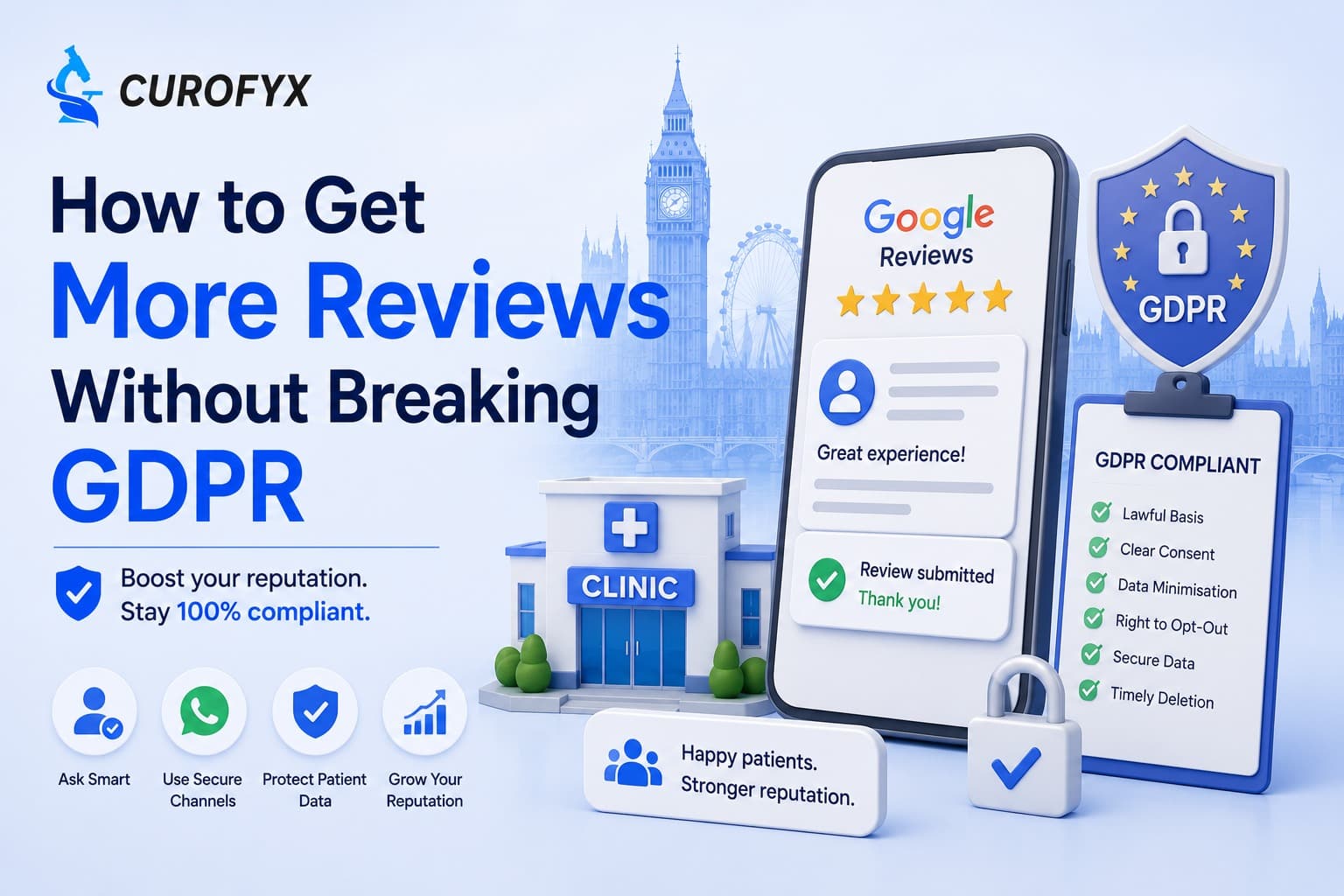
Many UK clinics avoid asking for patient reviews because they're worried about GDPR. That's understandable, but it's often based on misconceptions. This guide explains the lawful ways to request reviews, where consent actually matters, and gives you a practical compliance checklist your practice can follow with confidence.
A surprising number of healthcare practices have the same unwritten rule. "Don't ask patients for reviews. GDPR won't allow it."
The problem is that GDPR rarely says that. More often, it's an assumption that has been passed from one practice manager to another until it becomes accepted as fact. The result is predictable. One clinic collects a handful of reviews every year because staff are nervous about sending follow-up messages. Meanwhile, a nearby competitor asks every suitable patient for feedback through a compliant process and builds hundreds of genuine reviews that strengthen local search visibility and patient trust.
If your practice wants to automate review requests while maintaining compliance, our WhatsApp Review Requests feature explains how scheduled patient feedback requests can be sent consistently after appointments while giving patients appropriate control over communications.
The difference isn't luck. It's understanding the rules. GDPR doesn't exist to stop organisations communicating with patients. It exists to ensure personal data is used fairly, transparently and securely. If your clinic understands the lawful basis for processing patient information and respects patients' rights, requesting reviews can form part of a compliant patient engagement strategy.
Where many healthcare providers get into trouble is by copying retail marketing tactics. Healthcare isn't retail. Patients share sensitive personal information. That changes the legal responsibilities around how you use their data. The good news is that compliance isn't complicated once you separate myths from actual GDPR requirements.
The first question every clinic should ask isn't, "Can we send review requests?" It should be, "What lawful basis are we relying on?" Under the UK GDPR, every use of personal data requires a lawful basis. You don't choose one because it's convenient. You choose the one that accurately reflects why you're processing patient information.
For many healthcare providers, review requests are commonly assessed under legitimate interests, although the appropriate lawful basis depends on the circumstances, your relationship with the patient and applicable privacy and electronic communications rules. That means the clinic has a genuine business interest in requesting patient feedback, provided that interest doesn't override the individual's rights and expectations.
This is where documentation matters. If your practice decides legitimate interests is appropriate, that decision shouldn't live only in someone's head. Record your reasoning, assess the potential impact on patients and make sure your privacy notice explains how patient contact information may be used after treatment.
Many practices skip this step. That's a mistake. If the Information Commissioner's Office (ICO) ever asks how you reached your decision, "We thought it seemed reasonable" isn't much of an answer. A simple Legitimate Interests Assessment helps demonstrate that your organisation considered necessity, proportionality and patient expectations before sending review invitations.
A review request sent shortly after an appointment is generally easier to justify than one arriving six months later after the relationship has effectively ended. Patients expect some follow-up communication after receiving healthcare. They don't expect indefinite marketing. That's an important distinction. Another consideration is the communication channel itself.
Email and SMS marketing in the UK may also be subject to the Privacy and Electronic Communications Regulations (PECR), alongside UK GDPR. Your clinic should assess both sets of rules before implementing automated review campaigns.
The safest organisations don't rely on assumptions. They work with documented policies that explain exactly why review requests are sent, who receives them and when they stop.
This is probably the biggest source of confusion in healthcare marketing. People often use the words consent and GDPR together so frequently that they assume consent is required every time personal data is used. It isn't. Consent is only one of the lawful bases available under UK GDPR. In many situations, another lawful basis may be more appropriate.
For review requests, many healthcare providers rely on legitimate interests, provided they have assessed that their interest in collecting patient feedback is balanced against the patient's rights and reasonable expectations. That assessment shouldn't be copied from another practice or downloaded from the internet. It should reflect how your own organisation communicates with patients.
Consent certainly has its place. If your practice wants to send ongoing promotional emails, newsletters or special offers, consent may well be required depending on the circumstances and the communication channel. But a single review invitation sent shortly after a genuine appointment is a very different type of communication.
The problem arises when clinics mix everything together. I've seen practices stop sending review requests entirely because someone believed every follow-up email required explicit consent. At the same time, those same practices continued sending appointment reminders, invoices and treatment summaries without questioning the lawful basis behind those communications.
That's backwards. Each type of communication should be assessed individually. Patients also expect common sense. If they've just attended your clinic and receive a polite message asking about their experience, that usually feels like a natural continuation of their care journey. If they receive another reminder three months later, another after six months and another asking them to recommend friends, the communication starts feeling like marketing rather than patient engagement. That's where risk increases.
Another point that often gets overlooked is transparency. Patients shouldn't have to guess why they're receiving a review request.
Your privacy notice should explain how contact details may be used after appointments, who processes the data, how long it's is retained and how patients can exercise their rights. Clear communication reduces complaints long before they become legal questions. The practices with the strongest compliance culture don't try to find loopholes. They make sure patients understand exactly what's happening with their information.
One review request isn't usually what frustrates patients. Feeling trapped is. If someone decides they don't want to receive review invitations in the future, that decision should be respected quickly and without unnecessary friction. An opt-out shouldn't require a phone call to reception, a lengthy email exchange or filling out multiple forms.
It should be simple. If you're sending review requests by email, include a clear way for patients to stop receiving future review communications where appropriate. If you're using SMS, provide straightforward instructions for opting out in line with the messaging service and applicable regulations. Healthcare providers sometimes worry that making opt-outs easy will dramatically reduce review numbers. In practice, that rarely happens.
Clinics that rely on several review platforms often struggle to apply opt-out preferences consistently. Using Multi-Platform Review Monitoring helps centralise patient feedback workflows instead of managing each platform separately. Most satisfied patients either leave a review or ignore the request. Only a small proportion actively opt out, and those patients probably wouldn't have left a review anyway. Respecting their preference strengthens trust and demonstrates that your organisation takes privacy seriously. Your internal systems matter just as much. It's no use honouring an opt-out in your email platform if the patient remains on another automated messaging system that continues sending review requests. Reception software, CRM systems, appointment platforms and review management tools all need to work together.
Otherwise, patients receive mixed messages. That's often where complaints begin. Staff training is equally important. Reception teams should know what happens when a patient asks not to receive further communications. There should be one documented process, not five different answers depending on who answers the phone. Consistency protects the patient. It also protects the practice. Clinics that treat opt-outs as part of normal patient service rather than an inconvenience usually experience fewer complaints and far stronger confidence in their overall GDPR compliance.
Ask a room full of practice managers how long review request data should be retained and you'll probably hear five different answers. Some assume it's acceptable to keep everything indefinitely because storage is cheap. It isn't. One of the core principles of UK GDPR is storage limitation. Personal data should only be kept for as long as it serves the purpose for which it was collected. Once that purpose has been fulfilled, the information should either be securely deleted or anonymised.
That doesn't mean deleting every patient record after a review request. Clinical records are governed by separate legal and professional retention requirements. Review request data sits in a different category. The contact details used to send a feedback invitation, campaign logs and marketing preferences should all have their own retention policy. For example, if your review platform stores message delivery logs, click history and review invitation records, decide how long those records genuinely need to be retained. Keep them long enough to demonstrate compliance, investigate complaints and manage patient communications, but not simply because the software allows unlimited storage. Many practices never review these settings. Five years later they discover thousands of outdated patient records sitting inside third-party marketing platforms that nobody has logged into for months.
That's unnecessary risk. The same applies when changing software providers. If you move from one reputation management platform to another, make sure old patient contact databases aren't left behind. Confirm how data will be deleted, whether backups remain and what contractual arrangements exist with the previous supplier. This is where vendor due diligence becomes part of GDPR compliance.
Healthcare organisations should know:
These questions should be answered before signing a contract, not after a data protection issue arises. Creating a documented retention schedule also makes audits much easier. If the ICO ever asks why particular data has been retained, your practice should be able to explain the business purpose rather than saying, "We've always kept it." That answer rarely satisfies regulators.
Think of this as a checklist to review every quarter rather than something you complete once and forget.
Practices that complete this checklist consistently usually find that GDPR becomes much less intimidating. Instead of wondering whether every review request creates legal risk, they have documented processes that support both compliance and patient trust.
Yes, provided the request complies with UK GDPR, PECR where applicable, and professional guidance. The process should be fair, transparent and applied consistently rather than selectively targeting only happy patients.
Not always. Many healthcare providers rely on legitimate interests rather than consent for a single post-appointment feedback request. The appropriate lawful basis depends on the circumstances and should be documented.
Patients should have a straightforward way to opt out of future review communications where appropriate. Making this process simple demonstrates respect for patient preferences and supports GDPR compliance.
There is no fixed GDPR time limit. Practices should keep personal data only for as long as it is needed for the purpose it was collected and document their retention policy.
Yes, but the software provider acts as a data processor and should meet UK GDPR requirements. Practices remain responsible for ensuring appropriate contracts, security measures and retention controls are in place.
Automation itself is not a GDPR problem. In fact, well-configured automation often reduces human error by sending consistent, documented communications at the correct time while respecting opt-out preferences.
The clinics that struggle with GDPR usually aren't breaking the rules on purpose. They're relying on assumptions, outdated advice or inconsistent processes. Collecting more patient reviews and respecting privacy are not competing priorities. Done properly, they reinforce each other. For clinics looking to automate compliant review requests, monitor patient feedback across multiple platforms and manage responses from one dashboard, explore our solution for Private Clinics. Build your review process around a documented lawful basis, keep patient communication transparent, respect opt-outs and regularly review how your data is handled. Once those foundations are in place, you can confidently scale review generation without creating unnecessary compliance risks. You can also see how AI Review Replies helps your team draft professional, compliant responses while keeping every reply under staff control before publishing.
Get a live 1-on-1 walkthrough tailored to your clinic’s workflow and see how easily you can automate review requests, monitor your reputation, and reply with AI.