

Healthcare Reputation Specialists
Most GP partners know online reviews matter, but few calculate what poor reputation management actually costs. From staff hours spent chasing reviews to missed patient registrations, here's a practical breakdown of the financial return a five-doctor practice can expect from investing in a structured reputation management system.
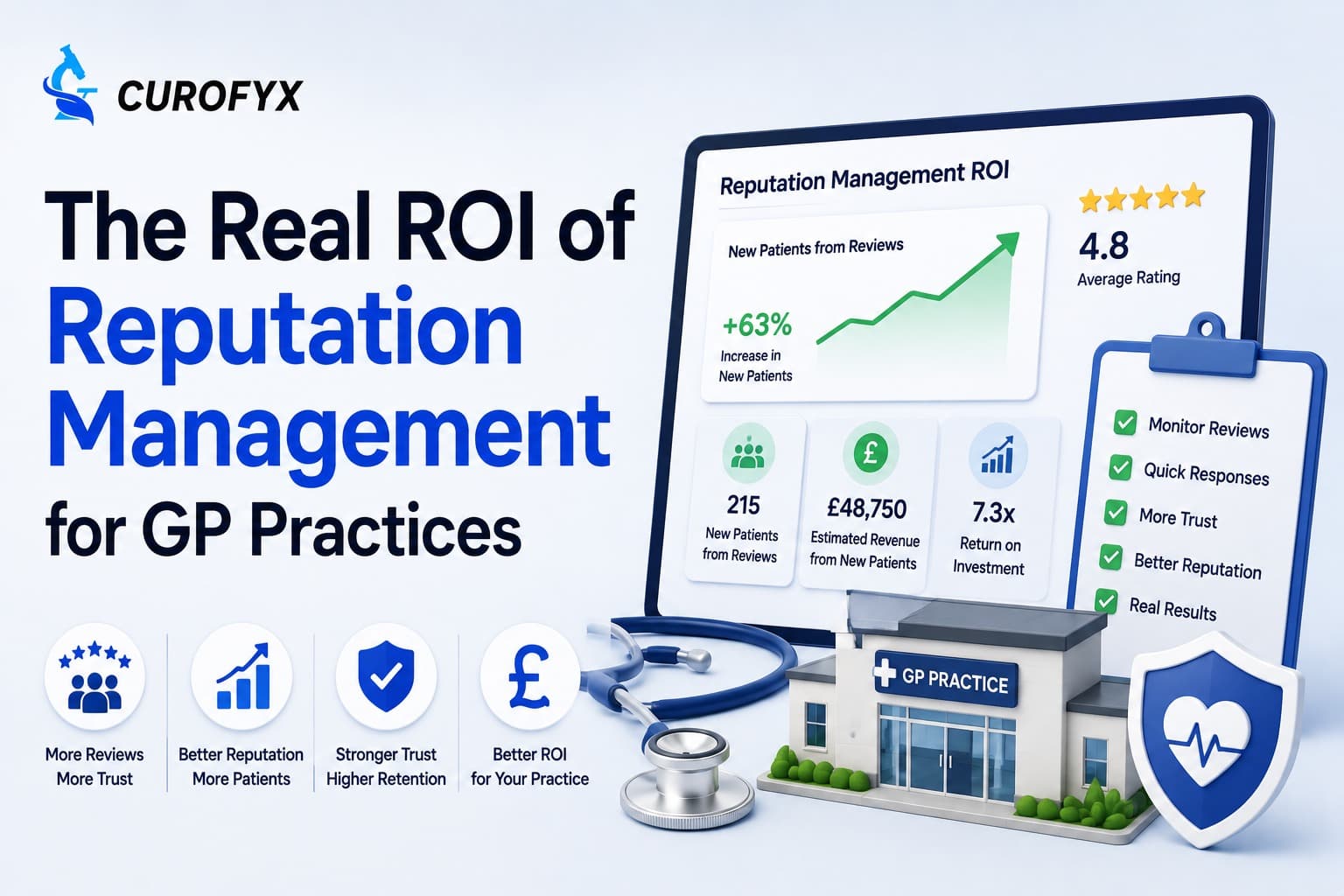
Ask a GP partner how much time the reception team spends dealing with reviews and you'll usually get a shrug. Nobody tracks it. Someone remembers to ask patients for feedback. Someone else checks Google every few days. A practice manager replies to difficult reviews when time allows. Negative feedback gets discussed in meetings, but positive feedback rarely gets used for anything. It feels like a collection of tiny tasks.
Across an entire year, those "tiny tasks" quietly consume dozens of staff hours while leaving plenty of reviews unanswered. For a typical UK practice with five GPs, reputation management has a measurable financial impact. The return isn't based on vanity metrics or collecting hundreds of five-star reviews. It comes from saving staff time, improving patient confidence, increasing registrations and reducing the risk of reputation issues becoming bigger problems. Let's put some numbers against it.
Every surgery differs slightly, but a representative five-GP practice might include:
| Metric | Typical Example |
|---|---|
| GPs | 5 |
| Registered patients | 10,000 to 14,000 |
| Reception/Admin staff | 8 to 12 |
| Patient reviews received monthly | 20 to 60 |
| Review platforms | Google, NHS website, Facebook, sometimes Trustpilot |
This size of practice generates enough patient feedback to influence local reputation, but not enough for manual processes to remain efficient. That creates the opportunity.
Most practices assume review management takes "a few minutes." It rarely does.
Think about every individual task:
Even if each review only takes seven or eight minutes from start to finish, the monthly total adds up surprisingly quickly. Twelve administrative hours every month equals roughly 144 hours every year. That's almost four working weeks. Those hours are usually carried by experienced reception managers or practice administrators whose time is already stretched.
Every hour spent manually checking review platforms is an hour not spent on:
This opportunity cost is what many partners overlook.
Unlike private clinics, GP surgeries don't always compete directly for appointments. They do compete for trust. People moving house often compare several nearby practices before registering. Google reviews heavily influence that decision.
Imagine two practices.
| Practice | Google Rating | Reviews |
|---|---|---|
| Practice A | 4.8 | 245 |
| Practice B | 4.4 | 39 |
Most patients won't analyse the numbers. They simply assume Practice A delivers a better experience. Even if clinical care is identical. Higher review volume creates stronger credibility because patients trust larger sample sizes.
Strong online reviews also affect:
Reputation spreads beyond patients.
Let's build a realistic scenario.
A five-GP practice currently receives:
After introducing an automated reputation workflow:
Six months later:
| Before | After |
|---|---|
| Average rating | 4.3 |
| Monthly reviews | 28 |
| Response rate | 41% |
| Staff time | 12 hrs |
That's a saving of approximately nine administrative hours every month. Across a year: 9 × 12 = 108 staff hours recovered. Those hours can be redirected into activities that directly improve patient experience.
Patients rarely expect perfection. They expect acknowledgement. An unanswered negative review from six months ago suggests the practice isn't listening. A polite response within 24 to 48 hours sends the opposite message.
It demonstrates:
For healthcare providers, those signals matter almost as much as star ratings.
Using tools like WhatsApp Review Requests also increases review volume because patients are asked while the appointment is still fresh.
Let's use conservative assumptions.
Annual software investment: £2,400
Administrative hourly cost: £24/hour
Annual hours saved: 108
Labour saving: 108 × £24 = £2,592
The software has already paid for itself through labour savings alone.
That calculation doesn't include:
Those become additional returns rather than the primary justification.
Here's the mistake many practices make. They try calculating ROI using only new patients. That's incomplete. The largest return often comes from operational efficiency.
When routine review management becomes automated:
Operational improvements compound over time.
Most staff don't delay replying because they don't care. They delay because writing healthcare responses takes time.
Every reply must be:
That naturally slows people down. AI-assisted drafting dramatically reduces that bottleneck. Instead of writing every response from scratch, staff review, personalise and approve suggested replies. The result isn't replacing human judgement. It's removing repetitive typing. Practices using AI Review Replies typically maintain far more consistent response rates without increasing workload.
Google isn't the only place patients leave feedback.
Practices increasingly receive reviews across:
Checking each platform manually almost guarantees something gets missed. Using Multi-Platform Monitoring centralises incoming reviews into one dashboard, reducing both response time and administrative effort.
Some benefits arrive almost immediately.
Practices expecting dramatic overnight patient growth will probably be disappointed. Practices looking for steady operational improvement usually see value much sooner.
Review requests work best when every patient receives the same opportunity. Random requests create random results.
Three-star reviews often contain the most useful operational feedback. They're far easier to improve than one-star complaints.
Review quantity, response rate and response speed all influence patient perception. Stars alone tell only part of the story.
This is probably the biggest mistake. Reputation management belongs alongside patient experience, governance and operational quality, not just marketing.
A realistic target is 30 to 60 genuine reviews each month, depending on appointment volume. Consistency matters more than occasional spikes.
Yes. Thanking patients demonstrates engagement and encourages others to leave feedback. Even brief responses strengthen trust.
Yes. Automated review requests, AI-assisted replies and centralised monitoring significantly reduce manual tasks while improving consistency.
Within 24 to 48 hours whenever possible. Faster responses reassure prospective patients that feedback is taken seriously.
Yes. Although patient registration works differently from private healthcare, online reputation still influences public perception, patient confidence and operational efficiency.
Track labour hours saved, review growth, response times, patient registrations and overall reputation trends together rather than relying on star ratings alone.
For most five-GP practices, the strongest business case for reputation management isn't attracting hundreds of extra patients. It's reclaiming staff time while building a reputation that patients trust before they ever walk through the door. The financial return starts with operational efficiency. The reputation benefits simply continue to grow from there.
If your practice is still managing reviews manually, it's worth comparing your current workload against a platform built specifically for healthcare providers. Solutions like GP Surgery Reputation Management and Reputation Score Analytics make that comparison surprisingly straightforward.
Get a live 1-on-1 walkthrough tailored to your clinic’s workflow and see how easily you can automate review requests, monitor your reputation, and reply with AI.