
Healthcare Reputation Specialists
Healthgrades and Google serve different parts of the patient journey. Healthgrades can help patients compare doctors inside a healthcare-focused directory, while Google controls a much broader local discovery layer. For most small US clinics, the smartest approach is not choosing one forever. It is deciding which platform deserves attention first, then building a review strategy around that priority.
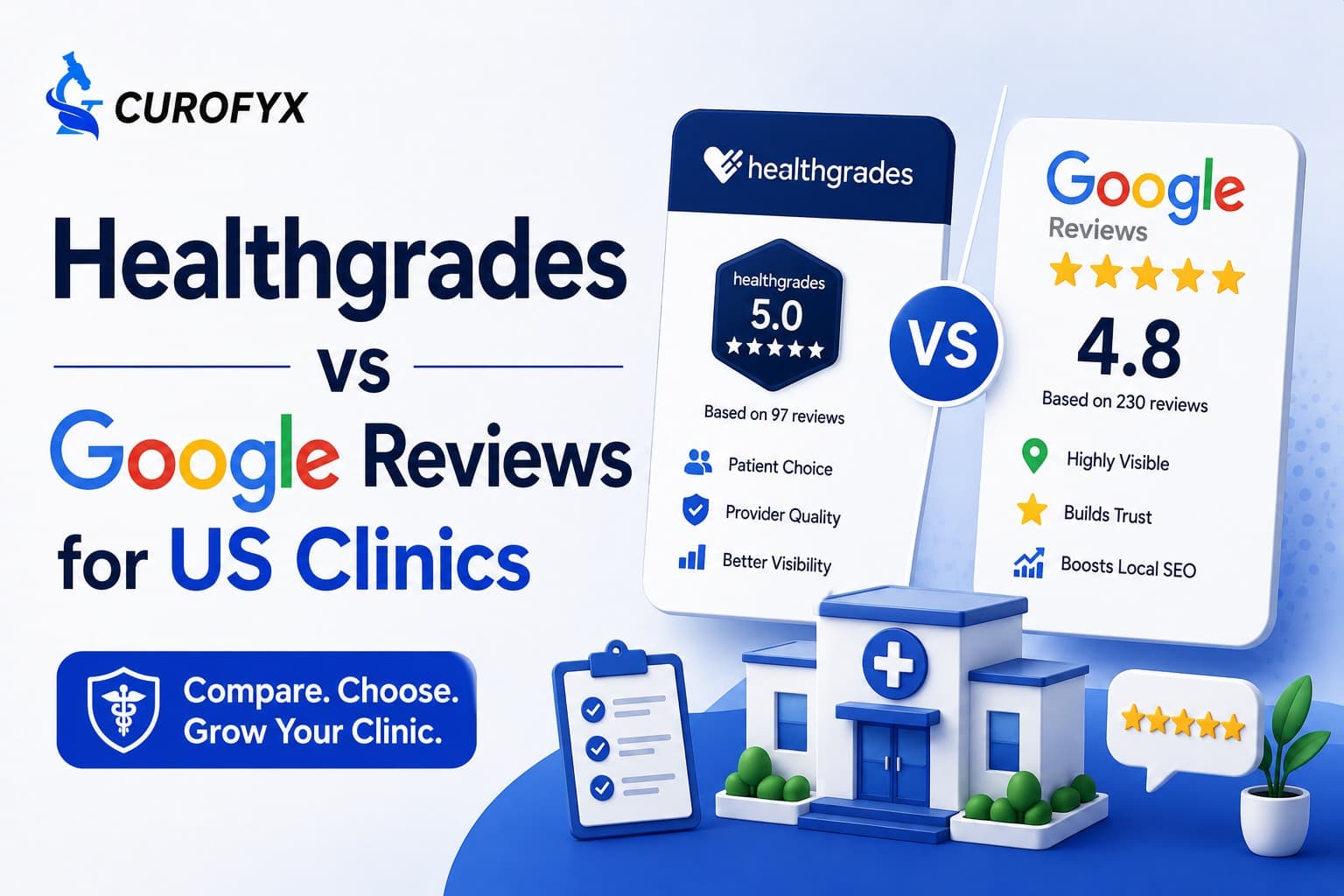
A clinic owner can spend hours polishing a Healthgrades profile and still miss the patient who searches Google for a nearby specialist. That is the central issue behind the Healthgrades vs Google Reviews debate. The two platforms are not really competing for exactly the same job. Healthgrades is a healthcare discovery platform built around doctors, specialties, conditions, procedures, patient ratings and appointment information. Google is a general-purpose discovery engine where healthcare providers compete for attention alongside every other local business.
Healthgrades says it has profiles for every doctor in America and more than 13 million patient ratings. Its search experience lets people look for doctors by name, condition, procedure and location. Google plays a different role. Its Business Profile appears across Google Search and Maps, and Google says local ranking is primarily influenced by relevance, distance and prominence. Reviews form part of the information used to assess prominence.
Healthgrades is valuable because the people using it are already in a healthcare decision-making environment. A patient can search for a doctor, narrow by specialty or location, look at ratings and read comments about the patient experience. Healthgrades also publishes provider information and patient feedback directly within its own ecosystem. Its specialty directory includes categories ranging from family medicine and dentistry to chiropractic, dermatology and orthopaedic surgery.
That creates a different kind of visibility from Google. A patient searching Healthgrades for an orthopaedic surgeon is already thinking about healthcare. The platform is not asking them to decide whether they want a provider. It is helping them compare providers. Healthgrades also gives practices a profile they can claim and manage. The company says doctors who claim their free profile connect with the right patients twice as often, although this is a Healthgrades marketing claim rather than an independent industry benchmark. That distinction is worth making because healthcare marketing gets littered with numbers that sound authoritative but are actually vendor claims. The review environment itself has useful safeguards. Healthgrades says reviews are confirmed and audited before publication, and it states that doctors cannot pay for good reviews or pay to have negative reviews removed.
Think about the way a new patient actually searches. They might type: "dermatologist near me", "urgent care near me", "family doctor in Austin", "best chiropractor near Dallas", "pediatrician accepting new patients". Those searches are often happening on Google rather than inside a healthcare directory. Google's own documentation says local results are mainly based on relevance, distance and prominence. It also specifically says that prominence can be influenced by information such as links to a business and its reviews, with more reviews and positive ratings potentially helping local ranking.
That gives Google reviews a role that Healthgrades reviews cannot fully replace. Your Google Business Profile is tied to the place where the patient is already searching. The profile can show your clinic name, location, opening information, photos, services, website, phone number and review score. Google also displays review scores and total review counts directly in Search and Maps. That makes the review visible before someone ever reaches your website.
A patient does not need to visit your homepage to form an initial impression of your practice. They may see your Google listing first, compare it with two nearby clinics and make a decision from there. For that reason, Google should usually receive the first investment of time for a small local practice. If you operate several locations, the case becomes even stronger because each location has its own local discovery environment. A multi-location group should think about reputation at the location level rather than treating reviews as one giant corporate number.
There is no credible universal percentage that says Healthgrades produces X% of new patients while Google produces Y%. Any article giving you a neat split without showing the underlying clinic, specialty, geography and tracking methodology deserves skepticism. The better question is where your patients are discovering you.
For most independent practices, Google has the broader reach because it sits across local search, Maps and branded searches. Healthgrades is narrower, but its audience is highly relevant because people using the platform are specifically researching healthcare providers. Healthgrades itself says more than half of Americans who see doctors each year use the platform, but that figure is a Healthgrades-reported claim rather than an independent market-share measurement.
So the platforms should not be judged by review volume alone. A clinic could have hundreds of Healthgrades ratings and still have a weak Google presence. Another could have a strong Google profile but barely any Healthgrades activity. Which clinic is likely to be discovered more often through local search? The answer depends on the patient's search behaviour and the clinic's specialty, location and competition.
For a small practice, I would track four things separately:
| Metric | Healthgrades | |
|---|---|---|
| Local discovery | Very important | Limited compared with Google |
| Healthcare-specific discovery | Moderate | Strong |
| Reviews visible in local search | Strong | Mainly within Healthgrades |
| Priority for most small practices | First | Second |
Suppose you run a two-provider family medicine practice in Phoenix. You have one afternoon available for reputation work. You can either improve your Google Business Profile, respond to recent Google reviews and build a compliant review request process, or spend that same afternoon updating a secondary healthcare directory. The reason is simple: Google can influence discovery before the patient has decided which practice to investigate. Healthgrades is more likely to become useful after the patient enters a healthcare-specific research journey.
That does not make Healthgrades unimportant. It makes it second priority. Google itself recommends keeping Business Profile information complete and accurate because this helps Google understand what the business does and match it with relevant searches. A profile with the wrong category, outdated hours or incomplete information creates unnecessary friction. Reviews cannot compensate for a profile that fails to tell Google and patients what the practice actually is.
This is also where reputation management becomes more than asking for five-star reviews. You need a consistent process for collecting genuine patient feedback, monitoring new reviews and responding appropriately. If your practice has enough volume to make manual monitoring difficult, a dedicated reputation workflow can help. Curofyx's reputation score analytics can be relevant for practices that want a clearer view of reputation performance across locations and platforms.
Putting Google first does not mean ignoring Healthgrades. There are specialties and markets where healthcare directories matter more. A specialist whose patients frequently research providers by physician name may find Healthgrades particularly useful. Healthgrades also provides a healthcare-specific context that Google cannot fully replicate. Its doctor profiles include patient ratings alongside professional and healthcare information, and its search system allows patients to search by conditions, procedures and specialties.
There is another reason to keep the profile accurate: patients may search your doctor's name directly. Imagine a patient receives a referral to Dr. Patel. Before booking, they search the doctor's name. The Healthgrades profile may appear alongside the practice website, Google results and other directory pages. If the profile is incomplete, outdated or poorly presented, you have lost control of part of that research experience.
For a small US clinic with limited marketing resources, I would build the reputation programme in this order.
Start with the basics. Make sure the practice name, address, phone number, website, category, hours and services are accurate .Then look at the review profile itself. Are recent reviews being answered? Is the clinic generating feedback consistently? Are patients seeing a profile that looks active rather than abandoned? Google says businesses cannot pay for a better local ranking, so there is no shortcut where a larger advertising budget automatically buys better local placement.
Do not wait for patients to remember to leave a review. Build the request into an appropriate point in the patient journey. The request should be genuine and should not pressure patients to leave a particular rating or manufacture positive sentiment. This matters legally as well as ethically. The US Federal Trade Commission's Consumer Reviews and Testimonials Rule addresses deceptive conduct involving consumer reviews and testimonials, including fake or deceptive reviews. For healthcare businesses, the safer approach is straightforward: ask for honest feedback and let the patient decide what to say.
Once Google is in good shape, make sure Healthgrades is not an afterthought. Check the provider information, specialty, location, profile details and review activity. Healthgrades explicitly positions its platform around finding doctors and reading patient feedback, so an incomplete profile undermines the reason a patient is there in the first place.
This is where a reputation platform starts earning its keep. The problem with managing reviews manually is not replying to one review. It is remembering to check every location and every platform consistently. For a single-provider clinic, that might be manageable. For a practice with several clinicians, it quickly becomes an administrative task that nobody owns. Curofyx's multi-platform monitoring is designed around that problem, giving practices a way to monitor reputation activity across platforms rather than treating every review site as a separate task.
A growing review count feels good. It is not the metric I'd put at the top of the dashboard. Track calls, website visits, appointment requests and, where your systems allow it, the source of new patient enquiries. If patients are finding you through Google, your Google strategy deserves more attention. If Healthgrades is generating meaningful enquiries, its value is obvious. The data should decide the allocation.
Chasing a perfect rating is overrated. A clinic with nothing but flawless five-star reviews can look less informative than one with a strong rating and thoughtful responses to occasional criticism. Patients understand that healthcare does not always produce identical experiences. Appointment delays happen. Billing confusion happens. Communication sometimes goes wrong. The response matters. A public response should never disclose private patient information or confirm details about someone's treatment. Even if you know exactly who wrote the review, the public response is not the place to discuss their medical history. The FTC's broader health advertising guidance also reinforces the need for healthcare marketing claims to be truthful and properly supported. Testimonials cannot be used as a substitute for evidence behind health claims. For a clinic, that means a review should remain a review. Don't turn one patient's experience into a promise about what every future patient will experience.
If your Google profile is weak, start there. Make the profile complete. Respond to outstanding reviews. Put a legitimate review request process in place. Then claim and clean up your Healthgrades profile so that patients who research your doctors there see accurate information. Once those foundations are working, look at the wider reputation picture. If you're managing a specialist practice, a dental clinic or a multi-location healthcare group, the platform mix may change. A clinic can also have strong ratings while still suffering from poor visibility because its profile information, website or local search signals are weak.
For practices that want to connect reputation activity with a broader patient acquisition strategy, Curofyx offers solutions for private clinics, dental practices, and multi-branch groups.
No single platform is universally better. Healthgrades is valuable for healthcare-specific provider discovery and patient research, while Google is usually more important for local discovery through Search and Maps. For most small practices, Google should come first.
There is no reliable basis for claiming that Healthgrades reviews directly improve a clinic's Google local ranking. Google says its local ranking uses relevance, distance and prominence, and that reviews can contribute to prominence.
It can maintain profiles on both platforms, but review requests should be handled carefully. The clinic should seek genuine patient feedback rather than directing patients toward a predetermined positive outcome. The FTC's consumer review rules make deceptive review practices a serious issue.
No. Google explicitly says local ranking is based mainly on relevance, distance and prominence. Reviews are one factor within prominence, not a guarantee of a particular ranking position.
Yes, but responses need to protect patient privacy. A professional response can acknowledge the concern and invite the reviewer to contact the practice privately without confirming that the person was a patient or discussing clinical details.
For most small US practices, prioritise Google Business Profile and Google reviews first. Once that foundation is working, maintain Healthgrades so patients researching a specific doctor or specialty encounter an accurate, credible profile.
If you have limited time, don't split it 50/50 simply because two platforms exist. Start with Google because it sits closer to everyday local discovery. Then make Healthgrades strong enough that patients who use healthcare-specific search do not encounter an incomplete or neglected profile.
The best reputation strategy is therefore less about choosing a winner and more about assigning each platform the job it is actually good at. Google helps patients find the practice. Healthgrades helps patients research the provider. Your job is to make both experiences credible.
Get a live 1-on-1 walkthrough tailored to your clinic’s workflow and see how easily you can automate review requests, monitor your reputation, and reply with AI.