
Healthcare Reputation Specialists
Managing online reviews becomes far more complicated once your healthcare organisation grows beyond a handful of locations. Five branches can easily mean five different reputations. This article explains how successful clinic groups centralise review management, empower local teams and measure performance without creating unnecessary administrative work.
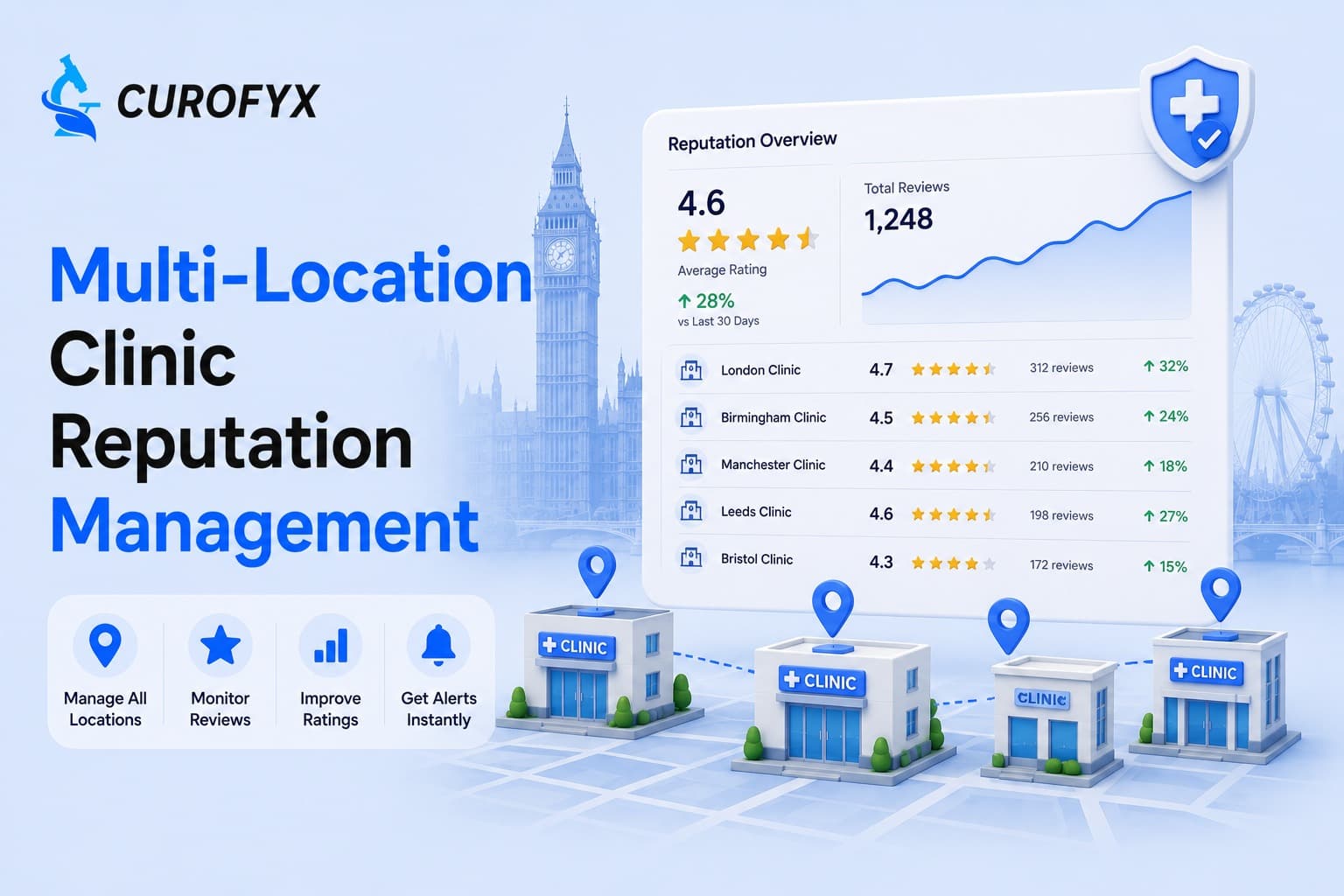
The first clinic opens in Bristol. The second opens in Manchester. A year later there are six locations across England. Growth feels exciting until someone Googles your brand. One branch has 420 Google reviews with a 4.9-star rating. Another has 34 reviews because nobody regularly asks patients for feedback. A third location hasn't replied to a negative review in four months because the practice manager thought head office was handling it.
From the patient's perspective, those aren't separate businesses. They're one brand. That's why reputation management changes completely once a healthcare provider expands beyond a single location. You're no longer protecting one Google Business Profile. You're protecting dozens of patient journeys that all contribute to the same reputation. The challenge isn't collecting more reviews. It's creating consistency across every branch without removing the local personality that patients value.
Fragmentation rarely happens overnight. It usually starts with good intentions. Each clinic manager is encouraged to manage their own Google Business Profile because they know their patients best. Reception teams respond to reviews when they have time. One branch asks every patient for feedback after an appointment, while another only sends requests when someone remembers.
After six months, every location has developed its own reputation strategy, even if nobody deliberately planned one. That's where problems begin. Head office might believe the organisation has an excellent online reputation because the flagship clinic consistently performs well. Meanwhile, two smaller branches quietly accumulate unanswered reviews, outdated opening hours and declining ratings. Those issues often go unnoticed until patients begin mentioning them during complaints or until local search visibility starts to fall.
Healthcare groups frequently underestimate how quickly inconsistency becomes visible online. Patients don't compare your branches against competitors first. They compare them against each other. Imagine a patient relocating from Leeds to Birmingham. They've had an excellent experience with your clinic before, so they search for your nearest branch. One location has hundreds of recent reviews, prompt responses from staff and updated photographs. The other looks neglected, with sparse feedback and unanswered criticism.
The patient naturally wonders whether standards have slipped. In reality, the clinical quality may be identical. The online reputation tells a different story. That disconnect creates unnecessary doubt before the patient has even walked through the door. Another issue appears as organisations continue expanding. Regional managers often spend hours manually checking every Google Business Profile to identify which locations need attention. One dashboard becomes ten browser tabs. Review notifications arrive in different inboxes. Some branches respond within hours, while others leave comments unanswered for weeks.
At that point, reputation management stops being a marketing task and becomes an operational challenge. Large dental groups, physiotherapy networks and private healthcare providers all encounter this transition. The organisations that adapt early build scalable systems. Those that don't usually find themselves reacting to reputation problems instead of preventing them.
One of the biggest mistakes healthcare groups make is swinging too far in one direction. Some hand complete responsibility to head office. Others leave every branch to manage its own reputation without any oversight. Neither approach works particularly well. If every review is handled centrally, responses quickly become generic. Patients can tell when they're reading a templated reply written by someone who has never visited the practice. A response that says, "Thank you for your valuable feedback," isn't reassuring when the review mentions a specific receptionist, consultant or treatment room.
On the other hand, giving every branch complete freedom creates inconsistency. One practice manager responds professionally within an hour, another replies two weeks later, and a third never responds at all. Before long, every location has developed its own tone of voice, its own response standards and its own way of dealing with complaints. Patients don't see independent branches. They see one healthcare brand. Head office should decide how reviews are handled, what standards every location follows and how performance is measured. Local teams should provide the personality because they're the people who actually know what happened during the appointment. Take a dental group with twelve practices. A patient leaves a five-star review mentioning a hygienist by name. The local practice manager is in the best position to reply because they know the clinician and can thank the patient in a genuine way. Now imagine another patient alleges poor treatment or raises concerns about clinical advice. That review shouldn't be answered immediately by an individual receptionist trying to resolve a potentially sensitive issue. It should follow a group-wide process involving senior management or the compliance team before any public response is posted. The same principle applies to brand presentation. Patients expect every location to look like part of the same organisation. Business descriptions, photography standards, service categories and response tone should remain consistent across every branch. Local managers can personalise replies, but the overall experience should still feel unmistakably like your organisation. This is particularly important for healthcare providers operating across several cities. A patient moving from Glasgow to Liverpool should feel they're dealing with the same clinic group, even though the staff and location have changed.
Technology makes this much easier than it used to be. Modern reputation management platforms allow head office to create response guidelines, approval workflows and brand standards while still giving individual branches enough flexibility to communicate naturally with their own patients. That balance prevents reviews from sounding robotic without sacrificing consistency.
Many healthcare groups track only one number. Their overall Google rating. It's easy to understand why. A single score looks reassuring on a monthly board report. The problem is that averages hide problems. Imagine a healthcare organisation with eight locations averaging 4.8 stars. At first glance, everything appears healthy. Then someone looks a little closer. Six branches sit comfortably above 4.9 stars, one has slipped to 4.4 and another has fallen to 3.9 after a series of unanswered complaints. The group average barely changes, but one location is already losing patient trust and local search visibility. That's why relying solely on organisation-wide reporting is risky.
The most effective healthcare groups measure performance at two different levels.
The first is branch performance. Every location should be assessed on its own reputation because that's what local patients actually see. Managers need visibility into review volume, average rating, response times and trends over time. Those figures help identify where additional support or training is needed before small issues become long-term reputation problems.
The second is group-wide performance. Senior leadership doesn't need to read every individual review. They need to understand whether the organisation is improving overall, whether certain regions consistently outperform others and whether operational changes are affecting patient satisfaction across multiple locations.
| Per-Branch Reporting | Group-Wide Reporting |
|---|---|
| Identifies issues affecting individual locations | Measures overall brand reputation |
| Helps branch managers improve local performance | Helps leadership monitor strategic trends |
| Tracks local response times and review growth | Compares regions, brands or divisions |
| Highlights operational issues unique to one clinic | Reveals organisation-wide patterns requiring investment |
| Supports coaching and accountability | Supports executive decision-making |
Another benefit of branch-level reporting is benchmarking. Healthy competition often develops naturally when managers can see how their location compares with others in the same organisation. One branch consistently generates twice as many patient reviews as another.
Instead of assuming the difference is due to demographics, leadership can investigate what that team is doing differently. In many cases, the answer isn't bigger marketing budgets. It's simply a better review request process, faster response times or stronger engagement from reception staff. Those best practices can then be shared across the entire organisation. That's how multi-location reputation management becomes a continuous improvement process instead of a monthly reporting exercise.
The technology isn't usually the problem. The workflow is. I've spoken to healthcare groups with twenty or thirty locations that invested in sophisticated reputation management software, only to discover six months later that response times hadn't improved. The platform was working exactly as intended. The people using it weren't clear about who owned each part of the process. A good workflow starts by accepting one reality.
Not every review needs the same level of attention. A straightforward five-star review thanking a receptionist shouldn't sit in a queue waiting for head office approval. The local team should be able to respond quickly while the interaction is still fresh. Fast replies feel genuine because they're usually written by people who actually remember the patient visit. The opposite applies to sensitive feedback. If a review mentions clinical negligence, safeguarding concerns, discrimination or a potential legal complaint, the response shouldn't depend on whichever staff member happens to read it first. Those reviews need a clear escalation path involving senior management, compliance teams or clinical leadership before anything is published publicly.
Another characteristic of successful multi-site organisations is visibility. Regional managers shouldn't spend Monday mornings opening fifteen different Google Business Profiles just to find out which branches received new reviews over the weekend. By the time they've finished checking one location, another review has probably arrived elsewhere. Instead, they need one place where every review appears in real time, regardless of which branch received it. From there, reviews can be filtered by location, rating, service line or response status. A regional manager can immediately see that Manchester has accumulated ten unanswered reviews while Bristol is responding within six hours. That kind of visibility changes the conversation from reacting to individual comments to improving operational performance across the entire network.
The best healthcare groups also establish service-level expectations. For example, positive reviews may be acknowledged within one working day, while negative reviews receive an initial response within a few hours before being investigated internally. The exact timing matters less than consistency. Patients notice when one location replies promptly while another appears to ignore feedback completely. Consistency builds confidence. It also makes internal reporting much easier because every branch is working against the same standards. This is where a centralised platform becomes genuinely valuable. Rather than switching between multiple Google Business Profiles or separate review websites, teams can monitor every location, assign reviews to the appropriate manager, track response times and identify branches that need additional support from a single interface. For healthcare organisations operating across multiple cities, that level of visibility quickly becomes a necessity rather than a convenience.
A platform such as Curofyx Multi-Platform Monitoring is designed around this model. Instead of treating each clinic as an isolated business, it allows head office and local managers to work together through one shared dashboard while still maintaining individual ownership at branch level.
The most effective approach combines central oversight with local ownership. Head office should define standards, reporting and escalation procedures, while individual branches respond to routine patient reviews because they understand the local context.
Yes. Each physical healthcare location should have its own Google Business Profile. This helps patients find accurate contact information, directions and location-specific reviews while improving local search visibility.
Healthcare groups should track average rating, review volume, response time, unanswered reviews, review growth and patient sentiment for every branch. Group-wide reporting should then combine these insights to identify trends across the organisation.
Routine complaints can usually be handled by local management following approved guidelines. Reviews involving patient safety, legal concerns or regulatory issues should follow an escalation process before any public response is published.
Without central oversight, different branches often develop different standards for collecting and responding to reviews. A centralised workflow ensures consistent branding, faster responses and clearer reporting across every location.
Yes. Reviews frequently highlight recurring issues such as appointment delays, communication problems or reception bottlenecks. When analysed across multiple locations, they become valuable operational data rather than just marketing feedback.
Managing reviews for one clinic is relatively straightforward. Managing them for ten clinics without losing consistency is something entirely different. The organisations with the strongest reputations aren't necessarily the ones with the most reviews. They're the ones where every branch follows the same standards, leadership has complete visibility and local teams still have enough freedom to respond like real people. As your clinic network expands, reputation management becomes less about replying to reviews and more about building a process that scales with your organisation. Get that process right, and every new branch strengthens the brand instead of creating another reputation to manage.
Get a live 1-on-1 walkthrough tailored to your clinic’s workflow and see how easily you can automate review requests, monitor your reputation, and reply with AI.