GSTIN: 122287344983902H
GSTIN: 122287344983902H



A Malaria Parasite (Card Test) is a rapid diagnostic test used to detect the presence of malaria infection in the blood. It identifies specific malaria antigens (such as Plasmodium falciparum and Plasmodium vivax) and provides quick results to support early diagnosis. This test is commonly used in suspected malaria cases to confirm infection and guide timely treatment. It is especially useful in emergency and point-of-care settings due to its fast turnaround time.
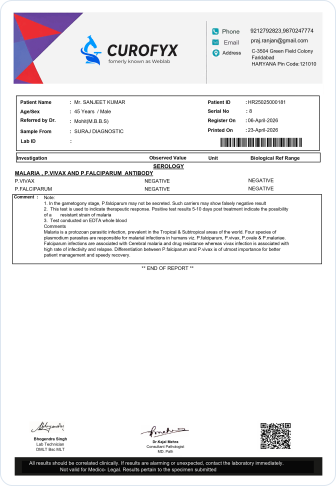
Plasmodium falciparum (HRP2) antigen
Pan-malaria (pLDH/aldolase) antigen
The Malaria Parasite (Card Test), also known as a rapid diagnostic test (RDT), is designed to detect antigens from malaria parasites in a patient’s blood. This test is widely used because it provides quick results, making it ideal for diagnosing malaria in areas where timely intervention is critical. The card test is simple, involving the application of a blood sample to a test card, which displays results in just 15–30 minutes.
Here’s what an ideal Malaria Parasite (Card Test) report format should include:
All Malaria Parasite (Card Test) results should be presented in a clear tabular format with columns such as Test Name, Result, and Interpretation/Flag. Key parameters include:
Values falling outside the normal range should be clearly highlighted (e.g., bold, color-coded, or flagged as High/Low) to improve readability and quick clinical interpretation.
This is a qualitative test where results are based on the presence or absence of antigen bands. A negative result indicates no malaria antigen detected, while a positive result suggests malaria infection. HRP2 positivity indicates P. falciparum and pLDH positivity indicates non-falciparum species. Results should always be correlated with clinical findings, and confirmatory testing may be required if suspicion remains high.
A brief interpretation section helps both clinicians and patients understand the results. For example:
Modern lab software often auto-generates these interpretations, making reports more patient-friendly and reducing manual effort.

In Curofyx software, this is the inbuilt interpretation for Malaria Parasite (Card Test)
Four species of the plasmodium parasites are responsible for human malaria infections: P. falciparum, P. vivax, P. ovale and P. malariae. Early detection and differentiation of malaria is of paramount importance due to incidence of cerebral malaria and drug resistance associated with P. falciparum malaria causing most of the morbidity and mortality worldwide.
The current test is a qualitative test for detection of the P. falciparum specific histidine rich protein-2 (Pf. HRP-2) and P. vivax specific lactate dehydrogenase (pLDH) in whole blood samples. The assay is able to detect and distinguish P. vivax and P. falciparum infections and also identify mixed infections.
The test detects P. falciparum specific HRP-2 and P. vivax specific LDH, a negative test result does not rule out infection with P. ovale and P. malariae. Constant exposure to the malarial parasites, as seen in areas of high endemicity, may result in positive results with doubtful clinical significance. Hence, the results must always be correlated with clinical history and relevant epidemiological and therapeutic context.
Get a live 1-on-1 walkthrough tailored to your lab’s workflow and see how easily you can automate reporting, billing, and daily operations.

A complete pathology lab system to handle patient records, test workflows, automated reporting, billing, and instant report sharing all in one place.