GSTIN: 122287344983902H
GSTIN: 122287344983902H



The Widal Test is a blood test used to help diagnose typhoid fever by detecting antibodies against Salmonella bacteria (S. typhi and S. paratyphi). It measures antibody titers such as O (somatic) and H (flagellar) antigens. Elevated titers may suggest current or past infection, depending on clinical context and baseline levels. The Widal test is commonly used in areas where typhoid is prevalent and supports diagnosis alongside clinical findings and other laboratory tests.
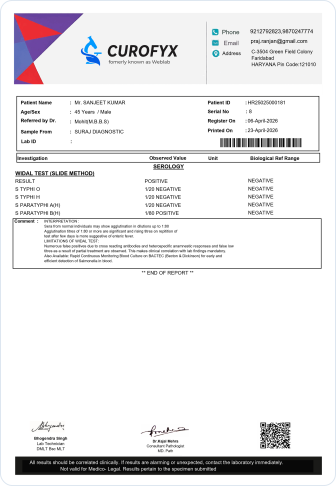
Salmonella typhi O Antigen (TO)
Salmonella typhi H Antigen (TH)
Salmonella paratyphi A H Antigen (AH)
Salmonella paratyphi A H Antigen (AH
The Widal (Slide Method) test is a diagnostic tool used to detect typhoid and paratyphoid fever, bacterial infections caused by Salmonella typhi and Salmonella paratyphi. By measuring the presence and concentration of specific antibodies (O and H antigens) in a patient’s blood, this test helps determine whether an infection is present and, if so, the degree of the immune response. In the slide method, a sample of the patient’s serum is mixed with specific antigen solutions on a glass slide. If antibodies for Salmonella bacteria are present, they bind to these antigens, resulting in a visible reaction, or agglutination. This reaction confirms a positive result. The strength of the agglutination, known as the titer, indicates the level of antibodies and thus the possible infection stage.
Here’s what an ideal Widal (Slide Method) report format should include:
All Widal (Slide Method) parameters should be presented in a well-structured tabular format with columns such as Test Name, Result, Unit, and Reference Range/Interpretation. Key parameters include:
Results are typically reported as Reactive / Non-Reactive (qualitative) or semi-quantitative based on visible agglutination intensity. Any positive (reactive) result should be clearly highlighted for easy interpretation.
In the slide method, results are generally qualitative rather than numerical, so standard reference ranges are not provided in the form of values. Instead, reports are interpreted as either non-reactive, indicating findings within normal limits, or reactive, which may suggest a possible infection and should always be correlated with clinical findings. It is also important to note that baseline titers can vary across different regions, and therefore interpretation should take into account locally established endemic reference patterns
A brief interpretation section helps both clinicians and patients understand the results. For example:
Modern lab software may assist in standardizing these interpretations for clarity and consistency.

In Curofyx software, this is the inbuilt interpretation for Widal (Slide Method)
1. Titres ≥1:80 of 'O' antigen & ≥1:160 of 'H' antigen for Salmonella typhi and titres ≥1:80 of 'H' antigen for Salmonella paratyphi A & B are significant.
2. Reactive results indicate ongoing or recent infection by Salmonella species and it will vary with stage of the disease with appearance in 1st week to increase in titres till end of 4th week post which it starts decreasing.
3. False positive - Past enteric infection during unrelated fevers like Malaria, Influenzae etc. in the form of transient rise in H antibody in Widal test.
4. False negative - Sample collected early in the course of disease (1st week) and immunosuppression.
1. To diagnose infection due to Salmonella species (Enteric fever).
2. To monitor the progression of disease.
3. To assess the response to therapy (decreasing titres) in patients being treated for Enteric fever.
Get a live 1-on-1 walkthrough tailored to your lab’s workflow and see how easily you can automate reporting, billing, and daily operations.

A complete pathology lab system to handle patient records, test workflows, automated reporting, billing, and instant report sharing all in one place.