GSTIN: 122287344983902H
GSTIN: 122287344983902H



A Prothrombin Time (PT) / INR test measures how quickly blood clots and evaluates the body’s clotting function. It helps detect bleeding or clotting disorders and assess liver function. The test is commonly used to monitor patients on blood thinners like warfarin. It is also important before surgeries to ensure proper clotting ability.
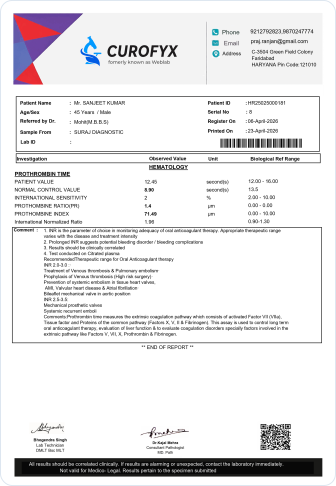
Prothrombin Time (PT)
International Normalized Ratio (INR)
Control / Reference Value (lab standard for comparison)
Prothrombin Time (PT) measures the time it takes for blood to clot, providing insights into clotting disorders or the efficacy of anticoagulation treatments like warfarin. The International Normalized Ratio (INR) standardizes PT results to account for differences in testing methods across labs. Together, PT/INR values help monitor patients with clotting disorders or those on blood thinners, making accurate reporting vital for effective treatment.
Here’s what an ideal Prothrombin time, PT/INR report format should include:
All Prothrombin Time (PT/INR) parameters should be presented in a well-structured tabular format with columns such as Test Name, Result, Unit, and Reference Range. Key parameters include:
Values falling outside the normal range should be clearly highlighted (e.g., bold, color-coded, or flagged as High/Low) to improve readability and quick clinical interpretation.
Each parameter must include appropriate reference ranges. PT values may vary slightly between laboratories depending on reagents used, while INR is standardized. Typical INR reference for healthy individuals is around 0.8–1.2, but target ranges may differ for patients on anticoagulant therapy.
A brief interpretation section helps both clinicians and patients understand the results. For example:
Modern lab software often auto-generates these interpretations, making reports more patient-friendly and reducing manual effort.

In Curofyx software, this is the inbuilt interpretation for Prothrombin time, PT/INR
PT evaluates the extrinsic and common coagulation pathways. The time required for fibrin clot formation is determined. It is most sensitive to deficiencies in the vitamin K-dependent clotting factors II, VII, and X. It is also sensitive to deficiency of factor V. It is less sensitive to fibrinogen deficiency and heparin. PT/INR tests are increasingly being used for monitoring warfarin therapy.
Increased in: Warfarin, liver disease, DIC, vitamin K deficiency, hereditary deficiency in factors VII, X, V and II, fibrinogen abnormality (eg, hypofibrinogenemia, afibrinogenemia, dysfibrinogenemia), circulating anticoagulant affecting the PT system (rarely lupus anticoagulant), massive transfusion.
Decreased in: Recombinant factor F VII treatment.
Warfarin therapeutic range is INR 2.0 - 3.0. Bleeding has been reported to be 3× more common in patients with INRs of 3.0–4.5 than in patients with INRs of 2.0–3.0.
Get a live 1-on-1 walkthrough tailored to your lab’s workflow and see how easily you can automate reporting, billing, and daily operations.

A complete pathology lab system to handle patient records, test workflows, automated reporting, billing, and instant report sharing all in one place.